Cheapest Cloud Storage per TB in 2026: Real Cost Breakdown
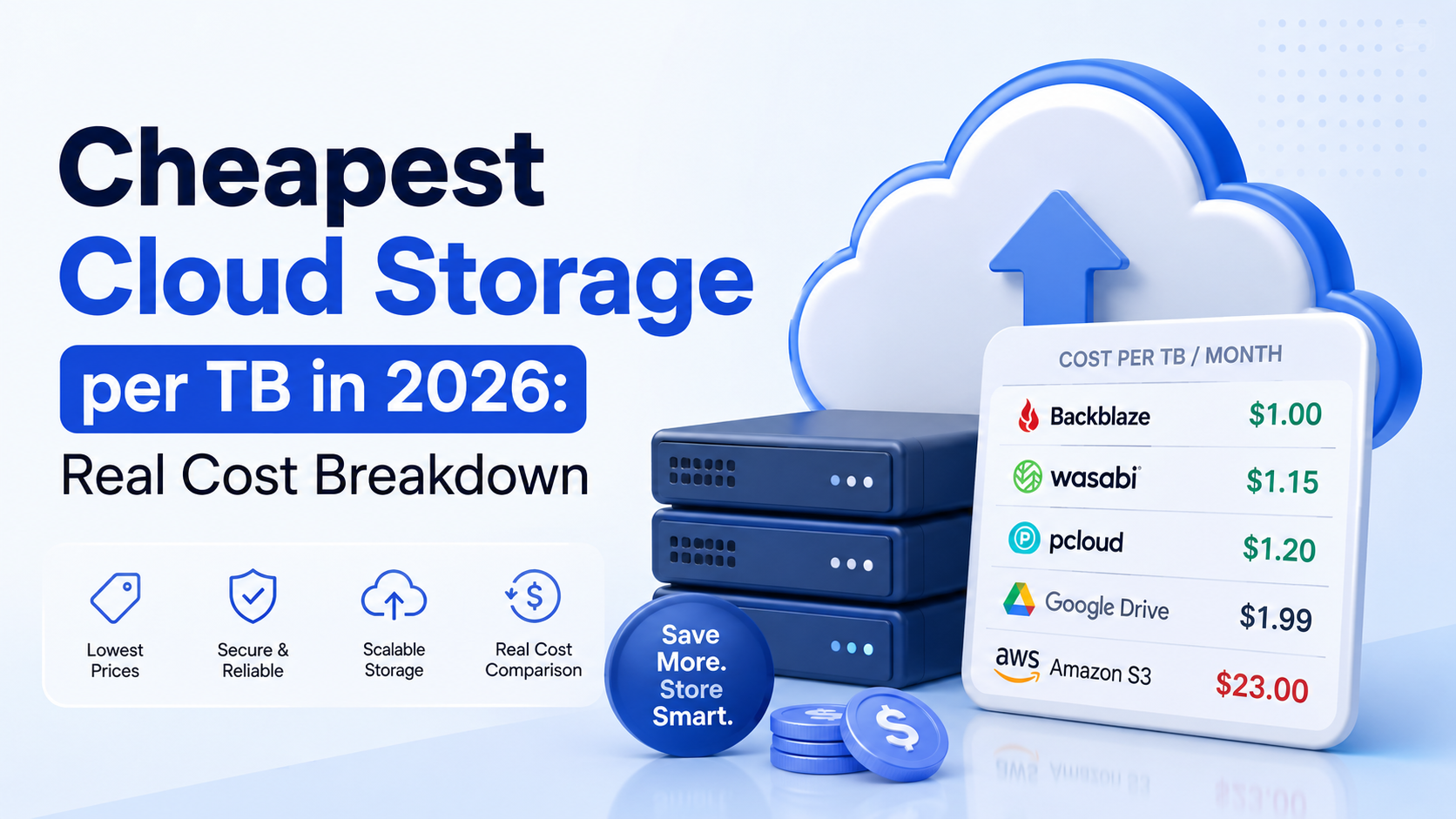
Why Advertised Prices Hide the Real Cost
You've seen the headlines: "Store 1 TB for $4/month!" or "Unlimited Cloud for
You've seen the headlines: "0!" These figures are powerful magnets, but they are rarely the final price you pay. The advertised cost per terabyte is often a theoretical anchor, calculated under perfect, unrealistic conditions that few users will ever experience. The real cost emerges from the shadows of your actual usage patterns, the fine print of the service agreement, and the operational necessities of your data.
The Mirage of the "Stored-Only" Terabyte
Providers love to quote the cost of a terabyte at rest. This is the simplest metric: the price to have 1,024 GB sitting passively on their servers. For example, a service might advertise $5/TB/month. However, data is rarely just at rest. The moment you need to upload it (ingress), download it (egress), or process it, additional charges apply. Think of it like buying a plot of land for $5, but then paying separate, often steep, fees every time you want to build a road to it, visit it, or modify anything on it.
The Architecture of Hidden Fees
The true cost structure is built on a foundation of operational fees. The most significant of these is egress—the cost to retrieve your own data. While many personal plans offer "free" egress, business and object storage tiers almost always charge for it, typically between $0.05 to $0.12 per GB. Downloading your full 1 TB just once could cost an additional $50 to $120, instantly doubling or tripling your annual storage bill. Other common fees include:
- API Request Costs: Every time software lists, writes, or reads an object, it's an API call. At $0.0004 per 10,000 requests, high-frequency applications can generate hundreds in monthly fees.
- Minimum Storage Duration: Some object storage providers charge for a minimum of 30, 60, or 90 days for any file uploaded, even if you delete it after 24 hours.
- Operations & Retrieval Tiers: To get the absolute lowest "cold storage" price, you often agree to high costs and long wait times (hours or days) to access your data.
A Concrete Example: The $5 TB That Costs $200
Let's model a realistic business scenario for a 1 TB archive. You choose a provider with a headline rate of $5/TB/month for cold storage.
| Cost Component | Calculation | Annual Cost |
|---|---|---|
| Storage at Rest | 1 TB x $5/month x 12 | $60 |
| Egress (One Full Retrieval) | 1,024 GB x $0.09/GB | $92.16 |
| API Calls (10 Million Reads) | (10M / 10,000) x $0.0004 | $40 |
| Minimum Duration Fees | (Assessed on deleted files) | ~$8 |
| Total Estimated Annual Cost | ~$200.16 |
Suddenly, the effective cost is over $16.50 per month—more than triple the advertised rate. This isn't deception; it's the business model. The advertised price is the entry ticket, not the full experience.
Cost per Terabyte Compared Across Providers
To cut through the marketing, we must compare like-for-like. For 2026, we've analyzed the base storage costs for 1 TB of data across major provider tiers, focusing on standard "hot" or frequently accessed storage where egress fees are a separate but critical factor. Remember, the lowest storage price often pairs with the highest operational costs.
The Landscape of Base Storage Pricing
The market has stratified into three clear tiers: consumer-focused personal cloud, business suites, and scalable object storage. Personal cloud services often bundle storage with other features, making pure TB cost comparisons tricky. Business suites (like Google Workspace or Microsoft 365) price per user, with storage pooled. Object storage (like S3 or Azure Blob) offers the most transparent, granular, and often lowest base price per GB, but with a pay-per-operation model.
| Provider & Plan | Advertised Price for ~1TB | Effective Monthly Cost per TB | Key Storage Model Notes |
|---|---|---|---|
| fii.one Standard Object | $4.99 / TB / month | $4.99 | Pure object storage. Price is for storage only; egress and requests billed separately. |
| Amazon S3 Standard | $0.023 / GB / month | ~$23.55 | Leading object storage. High durability, but complex pricing. |
| Google Cloud Storage Standard | $0.026 / GB / month | ~$26.62 | Comparable to S3. Often competitive on egress fees. |
| Backblaze B2 Cloud Storage | $0.006 / GB / month | ~$6.14 | Notable for low-cost storage and free egress up to a limit. |
| Microsoft 365 Business Basic | $6.00 / user / month (1 TB/user) | $6.00 (per user) | 1 TB per user, not pooled. Cost scales directly with user count. |
| Dropbox Professional | $19.99 / month (3 TB) | ~$6.66 | Simple, all-inclusive personal/professional plan. Egress/API costs are bundled. |
Reading Between the Numbers
This table reveals the core trade-off: simplicity versus granular control. Dropbox and Microsoft offer a predictable, all-inclusive monthly fee, ideal for individuals or teams who want no billing surprises. fii.one and Backblaze B2 offer radically lower base storage prices, appealing to developers and businesses with large archives where data retrieval is infrequent or managed carefully. The giants, AWS and Google, offer the deepest ecosystem and feature set, but their standard storage tiers are not the cheapest for raw capacity.
The "Free Egress" Advantage
Backblaze B2's model, mirrored by some newer entrants, is a game-changer for cost predictability. By offering a generous free egress allowance (often 1x or 3x your stored data), it eliminates the single largest variable cost for many users. When comparing, you must model your expected download volume. A provider with a $5/TB storage fee and $0.08/GB egress can be vastly more expensive than one with a $7/TB fee and free egress if you regularly access your data.
The Takeaway: The cheapest cloud storage per TB is not a single provider, but a formula: (Base Storage Price + (Egress Volume * Egress Cost) + API Costs). For a pure, rarely-accessed archive, fii.one or Backblaze lead. For active collaboration, a bundled business suite wins. For heavy compute integration, the major clouds' ecosystems may justify their premium.
Hidden Fees: Egress, API Calls and Minimum Retention
The advertised monthly rate for a terabyte of cloud storage is often just the entry ticket. The real cost is determined by how you interact with your data. Three categories of hidden fees can dramatically inflate your bill: egress, operations, and minimum retention policies.
Egress: The Cost of Getting Your Data Back
Egress fees are charges for downloading your data out of a provider's cloud. While many personal plans offer free egress, business and object storage tiers almost always charge for it. In 2026, standard rates range from $0.05 to $0.12 per GB. Retrieving a full 1 TB backup just once could cost between $50 and $120. Some providers, like fii.one, are challenging this model with more generous or predictable egress allowances, but for most, it remains a critical line item. High-volume data analytics or video streaming workloads can see egress costs eclipse storage costs by a factor of ten.
API Calls & Operations: The Penny-Per-Action Tax
Every time your application reads, writes, or lists files, it executes an API call (often called an operation or request). For object storage, these are typically priced per 1,000 requests.
| Operation Type | Typical Cost (per 1,000 requests) | Cost for 1 Million Operations |
|---|---|---|
| PUT / WRITE | $0.005 - $0.01 | $5 - $10 |
| GET / READ | $0.0004 - $0.002 | $0.40 - $2 |
| LIST / CLASS B | $0.005 | $5 |
A busy application performing millions of transactions monthly can add tens or hundreds of dollars to a bill. A poorly optimized sync client that constantly lists directory contents is a common culprit for unexpected charges.
Minimum Storage Duration & Early Deletion
To optimize their infrastructure, many providers enforce minimum retention periods, especially for deep archive tiers. If you upload 10 TB to a "cold" storage class with a 90-day minimum and delete it after 30 days, you will be billed for the full 90 days. Similarly, some services charge early deletion fees if data is removed before a set period (e.g., 180 days). This is crucial for dynamic datasets or development environments where data is frequently rotated. Always check the fine print for storage lifecycle rules; the cheapest per-GB archive tier can become expensive if your data churn is high.
The lesson is clear: true cost calculation requires modeling your specific data access patterns. A $5/TB/month service with high egress and API fees can easily become more expensive than a $10/TB/month service with a simple, all-inclusive model.
Personal vs Business vs Object Storage Pricing
Cloud storage isn't a monolith. Pricing and structure differ fundamentally between services designed for individual users, collaborative teams, and machine-driven applications. Choosing the wrong category for your needs is a fast track to overspending or underwhelming performance.
Personal Cloud Storage: Simplicity at a Scale Limit
Services like the premium tiers of Google One, iCloud+, and Dropbox Plus are built for individuals and families. Pricing is user-centric, with flat monthly fees for a bundle of storage, often shared across a few users. In 2026, 2 TB plans typically cost $10-$15 per month. The value includes seamless device sync, simple sharing, and integrated office suites. However, costs scale poorly with pure storage needs: needing 10 TB often means buying five 2 TB plans for $75/month, as there's no true "per TB" tier. It's convenient but rarely the cheapest cloud storage per TB at scale.
Business/Team Plans: Paying for Collaboration & Admin
Business plans from the same vendors (Google Workspace, Dropbox Business, Microsoft 365) add per-user licensing. You might pay Google0 per user/month for 1 TB of storage each. The primary cost driver is the number of seats, not raw storage. For a 5-person team needing 5 TB total, this is efficient (
Business plans from the same vendors (00/month). For a 2-person team needing 10 TB of shared archival data, it's disastrous—you'd pay for unused user licenses. These plans include vital admin controls, audit logs, and enhanced security, but you are fundamentally paying for collaboration, not just disk space.
Object Storage: Pure, Scalable Infrastructure
Object storage (like Amazon S3, Google Cloud Storage, Backblaze B2, or fii.one's core offering) is the raw material of the cloud. You pay only for what you use: storage volume, egress, and operations. There are no per-user fees. This is where you find the true cheapest cloud storage per TB for bulk data.
| Storage Tier (Object Storage) | Typical Price/TB/Mo (2026) | Best For |
|---|---|---|
| Hot / Standard (frequent access) | $15 - $25 | Active files, web assets |
| Cool / Infrequent Access | $5 - $10 | Backups, dev data |
| Cold / Archive | $1 - $4 | Long-term compliance, archives |
For example, storing 10 TB in a cold tier could cost just $20/month. The trade-off is complexity: you manage access via APIs, and retrieval from archive tiers can take hours and incur high fees. This model is ideal for applications, backups, and media libraries where access is programmatic and cost-per-GB is paramount.
Your decision hinges on a simple question: are you storing files for people or for programs? The answer defines the most cost-effective path.
When Cheap Storage Becomes Expensive
The allure of a low headline price per terabyte is powerful, but it's a siren song that can lead your budget onto the rocks. The true cost of cloud storage is dynamic, calculated not just by what you put in, but by how and when you need to get it out. Choosing a provider based solely on the storage rate is like buying a car for the price of the tires.
The Egress Trap: Your Data Held Hostage
Egress fees—charges for downloading your data—are the most common culprit. A provider may offer storage for $4/TB/month, but charge $90/TB for egress. Consider a 100TB archive. At that rate, your annual storage cost is $4,800. If you need to fully recover that archive once, your egress bill skyrockets to $9,000, nearly doubling your total cost. For active datasets or disaster recovery scenarios, this makes the "cheap" option prohibitively expensive. Some providers offer free or heavily discounted egress to their own cloud ecosystem or partner networks, which is only valuable if your workflow lives there.
API Avalanche: The Cost of "Talking" to Your Files
Object storage, while scalable, operates on a request-based model. Every LIST, GET, PUT, or DELETE command is an API call. At a penny per 10,000 requests, it seems negligible. But modern applications and sync clients can generate millions of calls. A backup job scanning 10 million files can cost
Object storage, while scalable, operates on a request-based model. Every LIST, GET, PUT, or DELETE command is an API call. At a penny per 10,000 requests, it seems negligible. But modern applications and sync clients can generate millions of calls. A backup job scanning 10 million files can cost $10 in LIST calls alone. A media application generating thumbnail previews for a 0 in LIST calls alone. A media application generating thumbnail previews for a large library could incur hundreds of dollars monthly in GET requests. These micro-charges silently accumulate, turning a $5 storage bill into a
Object storage, while scalable, operates on a request-based model. Every LIST, GET, PUT, or DELETE command is an API call. At a penny per 10,000 requests, it seems negligible. But modern applications and sync clients can generate millions of calls. A backup job scanning 10 million files can cost $10 in LIST calls alone. A media application generating thumbnail previews for a 05 invoice.
Minimum Duration and Deletion Penalties
Some deeply discounted tiers, particularly for cold or archive storage, come with stringent minimum retention periods. You might pay $1.50/TB/month for archive storage, but be locked into a 180-day minimum. If you delete a 10TB file after 30 days, you're still billed for the remaining 150 days—a $75 penalty that nullifies your initial savings. This model punishes agility and is ill-suited for temporary or rapidly changing data.
| Cost Factor | Example "Cheap" Plan | Potential Cost Impact on 10TB Workload |
|---|---|---|
| Storage Fee | $4.00 / TB / Month | $40 / Month |
| Full Data Egress (Once) | $90 / TB | + $900 One-Time Fee |
| High API Activity (10M GETs) | $0.01 / 10k Requests | + $10 / Month |
| Early Deletion (90 days early on 1TB) | 90-day minimum | + $13.50 Penalty |
The lesson is clear: you must model your total cost of ownership based on your specific access patterns. Cheap storage is only cheap if your data is truly at rest.
Picking the Right Tier for Your Workload
Selecting cloud storage isn't a one-size-fits-all decision; it's a matching game between your data's lifecycle and a provider's performance profile. The wrong tier leads to poor performance or bloated costs. The right tier feels invisible—it's just there, working affordably.
Mapping Data Temperature to Storage Tiers
Think of your data in terms of temperature. Hot data is actively processed: live project files, application databases, frequently edited documents. It needs millisecond latency and high IOPS, justifying premium tiers ($20-$25/TB/month). Cool data is accessed weekly or monthly: completed projects, reference archives, backup restores. Standard tiers ($6-$10/TB/month) balance cost and performance. Cold/Frozen data is for compliance or long-term backup, accessed rarely (<1/year). Archive tiers ($1-$3/TB/month) are perfect, despite slower retrieval times (hours).
The Performance vs. Price Equation
Performance metrics directly influence price. Consider throughput and input/output operations per second (IOPS). A video editing team streaming 4K footage from the cloud needs 1 Gbps+ throughput and high IOPS, requiring a premium block storage tier. A photo archive accessed by a few users daily needs moderate throughput but high durability, fitting a standard object storage tier. Picking a slower, cheaper tier for a performance-sensitive workload will cripple productivity, making any savings a false economy.
| Workload Type | Access Pattern | Recommended Tier | Typical Cost (per TB/mo) | Key Consideration |
|---|---|---|---|---|
| Active Development Files | Constant reads/writes, low latency | Premium/Performance | $22 - $25 | High IOPS & Throughput |
| Web App Asset Storage | Frequent reads, global delivery | Standard + CDN | $6 - $10 + CDN costs | Integration with delivery network |
| Monthly Backup Restores | Bulk reads, occasional writes | Cool/Infrequent Access | $3 - $5 | Low retrieval fees |
| Legal/Compliance Archive | Write once, read almost never | Archive/Glacier | $1 - $2 | Minimum retention duration |
Future-Proofing with Tiering Automation
The most cost-effective strategy is not picking one tier, but using several. Implement a lifecycle policy to automatically transition data as it cools. For example, a project file could move from Premium to Standard after 60 days of inactivity, then to Archive after 365 days. With a service like fii.one, this can be rule-based and seamless. This ensures you're always paying the optimal rate for the current value of the data, automating the relentless pursuit of efficiency that defines modern cloud economics.
Frequently Asked Questions
What is the absolute cheapest cloud storage per TB in 2026?
For pure archival of large, infrequently accessed data, object storage tiers from providers like fii.one, Backblaze B2, or Wasabi offer the lowest base rates, often under $5/TB/month. However, the "absolute cheapest" depends entirely on your access patterns. High data retrieval or egress fees can quickly erase savings from a low advertised price, making a slightly higher base cost with free egress more economical overall.
Are there any hidden costs I should watch for?
Yes, the main hidden costs are data transfer or egress fees, API request charges (for object storage), and minimum storage duration periods. Some providers charge for deleting data before a 90-day minimum. Always model your expected usage—not just storage volume, but how often you'll download data and how many files you'll manage—to see the true total cost of ownership.
Is personal cloud storage cheaper than business or object storage?
For small amounts of data (under 2TB), bundled personal plans can be simpler and cost-effective. However, once your needs scale into multiple terabytes, business-oriented object storage becomes significantly cheaper per terabyte. Personal plans often lack the security, compliance, and API features needed for business use, so compare based on your required functionality, not just price.
How does fii.one keep prices low without compromising reliability?
fii.one utilizes a modern, efficient architecture built on object storage principles, eliminating the overhead of legacy systems. By optimizing data center operations and leveraging smart tiering—automatically moving data to the most cost-effective storage class—we maintain robust durability and availability while passing the infrastructure savings directly to the customer, ensuring a trustworthy service at a cinematic tech scale.
When does choosing the cheapest storage become a mistake?
It becomes expensive when your workload requires frequent access. High-performance applications, active databases, or projects needing constant file retrieval will incur massive egress and operation fees on a cheap archival plan. The mistake is matching a high-access workload with a low-access price tier. Always align the storage class (hot, cool, archive) with your actual data retrieval patterns.
Join thousands of users who trust fii.one for fast, private cloud storage.
Get Started Free →fii.one Team
The fii.one blog brings you guides, tips, and insights on file storage, sharing, and productivity.